
Why finding a research topic feels so hard
What is SAMVIK AI TopicGen?
How it works — step by step
The 5 types of research gaps
Key features that set TopicGen apart
Who is it for? Use cases by level
Why TopicGen is different from every other tool
How to get started in under 2 minutes
Let's be honest. Finding an original research topic is one of the most stressful moments in any scholar's academic life. You know you need one. Your guide is waiting. The deadline is real. And you have no idea where to start. If that's you right now — this blog is written for you. SAMVIK AI TopicGen was built to solve exactly this. In 30 seconds.
Why Finding a Research Topic Feels So Hard — And Why It's Not Your Fault
We've spoken to thousands of researchers over 15 years. And almost every single one of them has told us the same thing: "I knew I was smart enough for research. I just didn't know where to start."
Here's a scene that will feel uncomfortably familiar. Your guide sends you a message on a Tuesday evening: "Come to my office Thursday with 5 original research topics and identify the gap in each." Your stomach drops. You open your laptop. You start Googling. You read 10 abstracts. Then 20. Then you're deep into a rabbit hole of papers and you have no idea what's been done, what hasn't, and whether anything you find is actually original. Thursday arrives. Your guide shakes his head.
This isn't a failure of intelligence. This isn't a lack of effort. This is what happens when a person is asked to manually navigate millions of research papers with no structured system to support them. The problem isn't you. The system was never designed to help you find a gap.
Information Overload — Millions of research papers across thousands of journals. No way to know what's been done and what hasn't.
No Gap Visibility — Scholars pick topics without knowing if a research gap exists — leading to rejections from guides and committees.
Months Wasted — Average time to finalise a PhD topic in India: 2—4 months. This delays the entire research journey.
India-Specific Gap — Global tools don't understand Indian academic contexts, domains, regulatory frameworks, or regional needs.
| Statistic | Value | Context |
|---|---|---|
| Average time to find a PhD topic | 2—4 months | Delays the entire research journey |
| Indian research gaps that are Geographic | 61% | Most common gap type for Indian scholars |
| Scholars who feel lost at topic selection | 87% | The system fails researchers at the very first step |
What is SAMVIK AI TopicGen? (And Why It's Different)
SAMVIK AI TopicGen is India's first AI-powered research topic generator — but calling it just a "generator" undersells what it actually does. It's more accurate to call it a research intelligence engine. One that thinks the way an expert researcher thinks, but works at the speed of a computer.
Here is the thing about most AI tools for research — they suggest topics based on patterns in their training data. They have no idea what has actually been studied, what gaps exist in real literature right now, or what is appropriate for your specific academic level. They guess. And when your guide asks you to justify your topic's originality, that guess falls apart.
SAMVIK AI TopicGen works completely differently. It connects your keywords and domain to real, live peer-reviewed journal databases, analyses the density of existing research, finds where the literature is thin, and then generates topics that are not just interesting — but genuinely original and defensible. With evidence.
The core difference: "Your guide picks your topic based on what they know. AI TopicGen picks it based on what the world hasn't studied yet — and shows you the evidence in real time."
It is not a writing tool. It is not a content generator. It is a research decision engine — the first step in your academic journey, done right, in 30 seconds.
How SAMVIK AI TopicGen Works — The Complete Step-by-Step Process
We know you're probably wondering: "This sounds great, but how does it actually work?" Fair question. Here's exactly what happens from the moment you hit submit — with no jargon, no fluff, just the real process:
You enter your research details — Name, research area, domain, keywords, and your academic level (UG / Masters / PhD / PostDoc). The level matters — it calibrates the entire output depth, paper quality, and gap threshold specifically for you.
SAMVIK's AI engine expands your keywords — Your input keywords are intelligently expanded into thematic clusters by SAMVIK's built-in research intelligence layer — ensuring the search covers the full scope of your domain, not just the literal words you typed. Think of it as having a senior research expert interpret your intent before querying the databases.
Real academic databases are searched — TopicGen queries OpenAlex, Semantic Scholar, CORE, Crossref, and domain-specific databases like PubMed and Europe PMC — fetching 30+ real peer-reviewed papers relevant to your domain and filtered to your academic level's citation standards.
Gap density analysis runs — The system analyses the density of existing research — identifying exactly where the literature is sparse. A topic with fewer than 40 papers in your domain at PhD level is flagged as a Gap. The same 40 papers might be Viable at Masters level. The threshold adapts to you.
5 original research topics are generated for you — SAMVIK's AI research engine generates 5 distinct, publication-ready research topic titles — each crafted with a gap explanation, novelty score out of 100, difficulty rating, suggested methodology, expected duration, and gap type classification. Every single topic is uniquely tailored to your academic level, domain, and the actual gaps found in the literature. No two outputs are ever the same.
Supporting papers are fetched per topic — For each of the 5 topics, real supporting papers are fetched from the databases — showing you the existing literature your topic builds upon and the gaps your research would fill. Papers include title, year, citation count, and journal name.
Want to see this in action? Try SAMVIK AI TopicGen free right now — no login, no credit card, results in 30 seconds.
The 5 Types of Research Gaps — And How TopicGen Identifies Each One
This is where TopicGen really earns its place. Most tools — if they do any gap analysis at all — just tell you that a gap exists. TopicGen tells you what kind of gap it is. This matters enormously, because the type of gap determines how you frame your research, how you justify it to your guide, and how you defend it to a committee. Here are the five types:
Geographic Gap
Temporal Gap
Methodological Gap
Population Gap
Theoretical Gap
Geographic Gap (most common for Indian scholars)
Global research exists on the topic but no studies have been conducted in the Indian context — or in specific Indian states, sectors, or demographics. This is the most powerful gap type for Indian researchers because it is easy to justify, easy to defend before a guide, and genuinely needed for Indian policy and practice. 61% of all research gaps identified by TopicGen for Indian scholars are Geographic.
Temporal Gap
Research exists but is outdated. The context has shifted significantly — due to COVID-19, new technology adoption, policy changes, or demographic shifts — making fresh research not just useful but essential. Temporal gaps are ideal for post-pandemic topics and emerging technology domains.
Methodological Gap
The topic has been studied, but always using the same method. A new methodology (mixed methods, machine learning approach, experimental design, systematic review) could yield fundamentally different insights. This gap type is particularly valuable for PhD candidates looking to contribute novel scholarly approaches.
Population Gap
Research exists for one group (urban, male, high-income, Western) but not for another (rural, female, low-income, Indian regional). Targeting an understudied population creates immediate originality and social impact.
Theoretical Gap
Existing theories do not adequately explain a phenomenon. New theoretical frameworks, models, or conceptual contributions are needed. This is the most ambitious gap type and is best suited for senior PhD and PostDoc researchers.
What Makes SAMVIK AI TopicGen Different — 6 Features That Actually Matter
There are a lot of AI tools out there making big claims. Here are the six features that actually make a difference when you're sitting across from your guide or committee — and why each one was built the way it was:
Level-Aware Intelligence — Every output — topic depth, paper quality, gap threshold, methodology suggestion — is calibrated to your specific academic level. A PhD topic and a Masters topic from the same keywords look completely different.
Novelty Score (0—100) — Each topic receives a novelty score that quantifies how original the research direction is. Scores above 75 indicate a strong research gap. This single number tells you more than hours of manual literature search.
India-Specific Angle — A dedicated chip identifies the India-specific research angle for your topic — including relevant states, policy connections (NEP 2020, AYUSH, DST), Indian data sources, and Indian journals to target.
Regional Gap Map — Shows research density by Indian region — North, South, East, West, Central — so you can identify not just that a gap exists, but exactly where in India it is most pronounced.
AI Research Advisor — After selecting a topic, you get an AI advisor who can answer questions about your gap, suggest narrower sub-topics, explain the methodology, and guide you deeper — all trained on your specific topic context.
PDF Research Report — Download a professional research report with your topic, gap analysis, novelty score, methodology, keywords, and supporting papers — ready to present to your guide, supervisor, or institution.
Who is SAMVIK AI TopicGen For? Real Use Cases by Academic Level
TopicGen was built for everyone doing academic research — but it adapts its output based on who you are. Here's how scholars at different stages are using it:
PhD Scholars — Finding a defensible doctoral topic that your committee can't reject
PhD committees require topics that demonstrate genuine contribution to knowledge. TopicGen's gap analysis — citing specific literature, quantifying novelty, and classifying gap type — gives you the academic language and evidence to defend your topic selection before any committee. PhD-level outputs come with Q1/Q2 journal targets, 3—5 year duration estimates, and advanced methodology suggestions.
Masters Students — Getting your guide to approve your topic on the first attempt
Most Masters students get their topics rejected 2—3 times before approval — simply because they don't know how to frame originality. TopicGen gives you 5 options, each with clear gap framing, so you walk into your guide meeting with confidence and evidence. The 12—18 month timeline estimate helps you pick a topic that is achievable within your degree constraints.
Undergraduate Researchers — Starting your first research project with direction
For undergraduates, the first research project is often overwhelming. TopicGen's UG mode generates broad, accessible topics using review papers, with simple methodology suggestions (survey, case study, literature review) and 3—6 month timelines. It removes the paralysis of starting and replaces it with a clear, evidence-backed direction.
Research Professionals — Identifying fundable research directions for grant applications
PostDoc and professional researchers use TopicGen to identify research directions that are novel enough to attract DST, UGC, ICSSR, or international funding. The Theoretical Gap type is particularly relevant here — identifying where new frameworks are needed creates the strongest funding case.
Why TopicGen is Different From Every Other Tool You've Tried
You've probably already tried Googling for research topics. Maybe you've even asked an AI chatbot. And you probably ended up with a list of ideas that looked plausible — but when you took them to your guide, they came back with the same response: "This has already been done" or "Where's the originality?"
That's the fundamental difference between those tools and TopicGen. Other tools work with what they know. TopicGen works with what the research world actually contains right now — querying live academic databases, reading real papers, and identifying where the gaps genuinely are.
"Most tools help you write about your research. TopicGen helps you decide what to research in the first place — and that is the decision that determines everything that follows."
When your guide asks you to justify your topic's originality, you won't be saying "I found it online." You'll be saying "Here is the gap in the existing literature, here is the novelty score, and here are the papers that prove it." That changes the entire conversation.
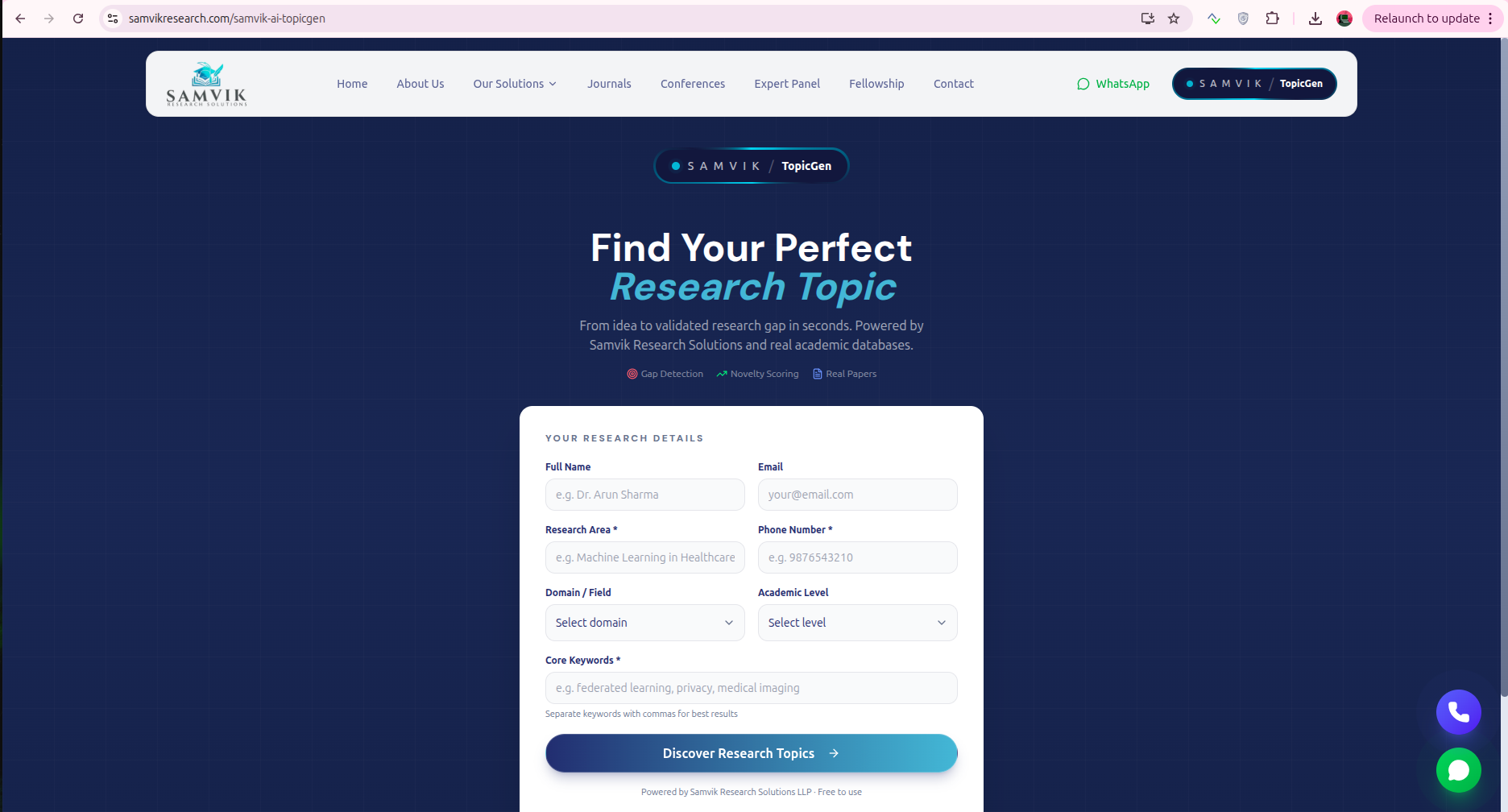
The live SAMVIK AI TopicGen interface — from idea to validated research gap in seconds. Try it free.
TIPReady to find your research gap right now? No login. No credit card. Results in 30 seconds. Try SAMVIK TopicGen Free.
How to Use SAMVIK AI TopicGen — Getting Started in Under 2 Minutes
We made this as simple as possible. No technical knowledge needed. No complicated setup. If you can type your research area into a form, you can use TopicGen. Here's exactly what to do:
Go to samvikresearch.com/samvik-ai-topicgen — No account required to try. The tool is free and accessible immediately from any device — mobile or desktop.
Enter your research area and keywords — Be specific but not too narrow. "Machine Learning in Healthcare" with keywords "federated learning, privacy, India" works well. The more context you give, the more relevant the topics.
Select your academic level — Choose UG, Postgraduate, PhD, or PostDoc. This one selection changes the entire output — depth, vocabulary, methodology, paper quality, and gap threshold.
Click "Discover Research Topics" and wait 30 seconds — The AI analyses real academic databases. In 30 seconds you receive 5 original, gap-validated research topics with novelty scores and supporting evidence. Your research journey begins here.
Your Research Journey Deserves a Better Start
We've been working with Indian researchers for over 15 years. We've sat across the table from thousands of brilliant, hardworking scholars who were stuck — not because they lacked ability, but because nobody gave them the right starting point.
That's what SAMVIK AI TopicGen is. It's not magic. It's not a shortcut around real research. It's simply the right starting point — the one that should have existed all along. The one that tells you where the gap is, shows you the evidence, and gives you the confidence to walk into your guide's office and say: "I found something original. Here's why."
The tool is live. It's free to try right now. And it was built by people who genuinely care about the quality and direction of research coming out of India. Your guide is waiting. Your gap is out there. Go find it.
TRY IT FREENo login required. No credit card. Results in 30 seconds. Your research direction starts here.
Find My Research Topic | Talk to an Expert
5000+ Scholars Guided | 15+ Years Experience | 4.9/5 Rating | All Domains Covered